
Every successful fire-sprinkler system begins with one principle: details always win. Choosing sch-10 or sch-40 may look like a simple specification step, but behind that choice sits decades of engineering logic influencing pressure ratings, thread performance, grooving behaviour, corrosion allowance, installation speed, and long-term reliability. When teams treat these details with care, they prevent rework, avoid hydraulic surprises, and build systems that stay dependable for decades. When they overlook them, even a well-designed system can become a maintenance liability. Understanding the differences between sch-10 and sch-40 is not just an engineering exercise—it is a foundation for sustainable fire protection.
Q1. What is the basic difference between sch-10 and sch-40 in fire-sprinkler systems?
Sch-10 and sch-40 refer to different pipe wall thicknesses.
- sch-10 → thinner wall
- sch-40 → thicker wall
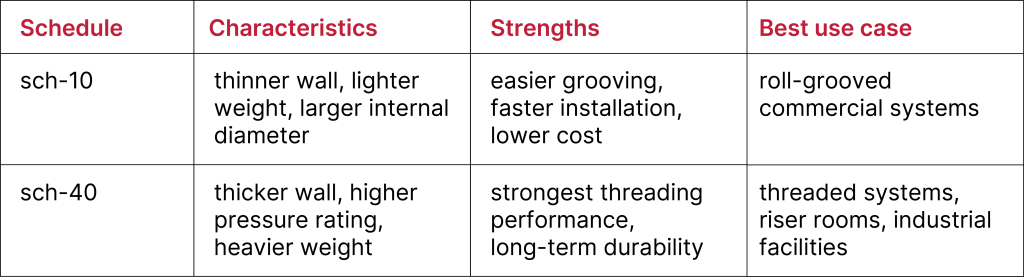
Sch-40 has greater mechanical strength and supports deeper threads, while sch-10 is lighter, has a larger internal diameter, and reduces overall material weight. In fire-sprinkler work, sch-10 is used mostly in roll-grooved systems, while sch-40 is traditionally used in threaded systems.
Q2. How does wall thickness affect hydraulics and system performance?
Sch-10 provides a larger internal diameter, which reduces friction loss and improves flow in long runs. This often results in better hydraulic performance for commercial wet systems.
Sch-40’s thicker wall increases its pressure rating, making it suitable for high-pressure zones, pump discharges, industrial hazards, and areas with elevated mechanical stress. Both schedules meet NFPA-13 requirements when properly UL/ULC/FM listed.
Q3. How do sch-10 and sch-40 behave differently in threading versus grooving?
Threading removes steel from the pipe wall.
Because sch-40 starts thicker, it retains enough material to form strong, leak-resistant threads. This makes sch-40 the preferred choice for threaded branch lines, risers, pump rooms, and mechanical spaces.
Sch-10 grooves smoothly and requires less force during fabrication, which speeds installation and reduces labour hours. For this reason, sch-10 is the industry standard for grooved commercial systems.
Q4. How do weight, installation effort, and cost differ?
Sch-40 is significantly heavier, increasing handling difficulty and installation labour. It also requires stronger supports and adds to lifting fatigue.
Sch-10 is lighter, easier to handle, and faster to install, leading to lower total installed cost. Although sch-40 is more expensive due to its steel content and fabrication requirements, it remains the right choice for threaded and industrial environments.
Q5. Is there any difference in certification compatibility?
Both sch-10 and sch-40 can be:
- UL listed
- ULC listed
- FM approved
Certification—not wall thickness—is what determines NFPA-13 acceptance.
Typical listings include:
- sch-10 → often listed under A135 and A795
- sch-40 → often listed under A53 and A795
Inspectors focus on documentation accuracy, heat number traceability, and proper certification matches.
Q6. How do sch-10 and sch-40 apply differently in commercial vs industrial buildings?
Commercial buildings favour sch-10 for most grooved mains and branches due to speed, handling ease, and installation efficiency. Sch-40 is typically reserved for risers, fire pump rooms, and threaded components.
Industrial buildings require higher durability. Elevated pressures, vibration, temperature fluctuations, and physical impact often make sch-40 the default schedule across more of the system.
Q7. How should contractors choose between sch-10 and sch-40?
Choose sch-10 when:
- the system is roll-grooved
- faster installation matters
- overall project cost needs to be reduced
- handling weight is a factor
- the project is commercial or multi-residential
Choose sch-40 when:
- the pipe will be threaded
- mechanical rooms or risers need added strength
- pressure demands are higher
- the building is industrial
- the AHJ prefers conservative safety margins
Comparison table: sch-10 vs sch-40